Big BGA Placement
Components on AI server boards are getting physically huge. ASMPT used October 2026 to introduce a new SOLO placement head built specifically for the large, heavy processor BGAs used in AI and high-performance computing - handling parts up to 240 x 240 mm and more than 2 kg, with a design path to 5 kg. The numbers tell the story: a year ago, large processor BGAs measured roughly 150 x 150 mm and weighed about 500 grams; the next generation has roughly twice the area and four times the weight. For SMT lines, that shift changes what placement equipment, board handling and process control must be able to do.
Industry Update
ASMPT's SOLO head, initially available on the SIPLACE SX platform, uses a new single-segment architecture with a strengthened and stiffened axis; the head-to-gantry connection and the nozzle-to-segment interface were redesigned to withstand greater mechanical loads, with a maximum placement force of 200 newtons. Because these processors can cost more than USD 20,000 each, handling them is a reliability problem as much as a speed problem: nozzles are matched to housing surfaces and avoid areas that must not be touched, while the head's motion profiles account for the large component's mass inertia, customizing acceleration and rotation for each device.
The placement step is also positioned carefully in the process. On a SIPLACE line, small components are placed first by high-speed heads, broad component ranges by other heads, and large or odd-shaped parts by a VHF head; the expensive processor BGAs go last, handled by the new SOLO head. Alongside the head, ASMPT points to heavier-duty conveyors for large, heavy boards and Smart Pin Support that prevents PCB bending and vibration during placement, plus pre-placement inspection of the processor area for foreign matter and correct spacer position, and post-pick optical checks with optional 3D laser triangulation of solder ball coplanarity.
What It Means for SMT Lines
- Board support and stiffness matter again: heavy boards with massive BGAs need more support pins and stiffer conveyors, or placement accuracy and coplanarity suffer.
- Single expensive components justify extra process controls - pre-placement area inspection, nozzle matching and placement-force limits become standard for AI server lines.
- Equipment selection must account for component mass: acceleration profiles, nozzle designs and head stiffness are now differentiators, not just placement speed.
- Operator safety and handling procedures need review: a dropped 2-5 kg board is both a cost and a safety event.
- For factories serving AI server customers, reflow and inspection must also adapt - large boards and heavy BGAs shift thermal profiles and inspection coverage requirements.
Outlook
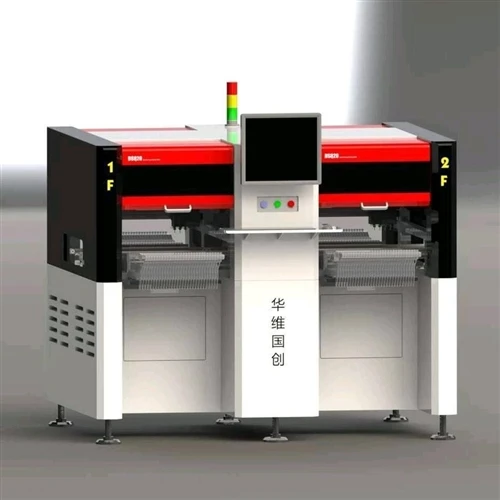
Expect processor packages to keep growing as multi-die architectures pack more silicon, memory and power delivery into one module. That will push placement platforms toward stiffer heads, heavier board handling and more in-line verification, while keeping the rest of the line optimized for speed. For mid-sized factories, the practical path is to separate high-value processor placement from high-speed passive placement and to select equipment whose suppliers understand both. HWGC, a China SMT machine manufacturer, supplies four-head to twelve-head pick and place machines, reflow soldering ovens, solder paste printers, wave soldering systems, PCB loaders, conveyors and AOI/SPI inspection equipment for SMT lines serving consumer, industrial and automotive electronics.
Foreign Trade Sales: Mr. Sun
Phone · WhatsApp · WeChat: +86 18210740377
Email: zghwgc@gmail.com
Website: www.smthw.com
Factory Address: Building 21, Junding Science & Technology Park, Shiyin Village, Luquan District, Shijiazhuang, Hebei, China