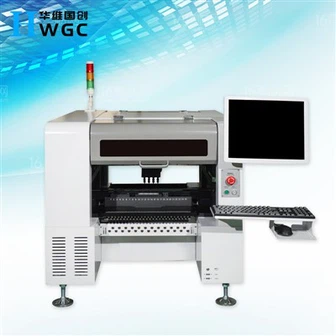
What is the role of the placement machine
The core elements of a pick and place machine are indispensable to modern electronic assembly automation. With continuous development and innovation, this technology has become essential in the production of modern electronic devices. The main components of a pick and place machine include the feeders, the placement head, and the controller.
The feeders are responsible for holding and supplying the components that will be placed onto the board. These parts can include small resistors, capacitors, and microchips, among other things. They are responsible for ensuring that each component is placed correctly and accurately. The placement head is the component that actually picks up the components from the feeders and places them onto the board. Modern machines can handle the placement of thousands of components per hour with high precision levels.
The controller is the brain behind the entire operation. It is responsible for coordinating communication between components and supervising the operation as a whole. Everything from the speed of the machine to the placement accuracy is controlled by the system. In addition, it can be programmed to perform specific tasks based on assembly requirements.
With the implementation of pick and place machines, the efficiency and effectiveness of electronic manufacturing have increased exponentially. These machines can effortlessly handle many components at once, reducing the time it takes to produce a board and improving the overall quality of the process.
Moreover, using a pick and place machine has become a necessary tool in modern electronic manufacturing. Without these machines, the production of electronic devices would be a lengthy, expensive, and labor-intensive process.
In conclusion, the development of pick and place machines and its core elements has revolutionized the field of electronic assembly and manufacturing. The feeders, placement head, and controller work together to simplify the process while ensuring high-quality and accuracy in product assembly. The integration of this technology has undoubtedly made an impact on the technological world and will continue to do so in the future.