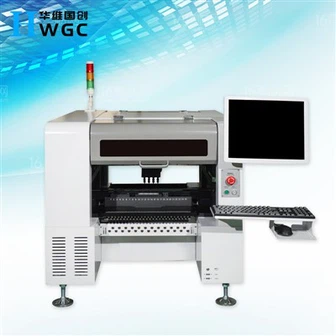
Innovative Technology in Pick - and - Place Machines: Practical Improvements in Component Placement Accuracy
Pick-and-place machines have been an integral part of the electronics industry for many years now. These machines are widely used to automate the process of placing and soldering electronic components onto printed circuit boards (PCBs). Over the years, there have been several advances in pick-and-place technology, resulting in increased accuracy, speed, and reliability.
One of the most significant improvements in pick-and-place technology is in component placement accuracy. This is crucial because even the slightest misalignment or deviation in component placement can result in a faulty PCB. To overcome this issue, manufacturers have introduced new technologies such as 3D machine vision systems, improved software algorithms, and higher resolution sensors.
Another vital improvement in pick-and-place technology is the incorporation of artificial intelligence (AI) and machine learning (ML) algorithms. These technologies help the machines learn from their past experiences, making them more efficient and accurate in their component placement. AI also helps in the optimization of machine settings and facilitates continuous improvement in the pick-and-place process.
The use of cobots, or collaborative robots, is another innovation that has transformed the electronics industry in recent years. Cobots are designed to work alongside human operators, and their implementation has resulted in increased productivity and efficiency. These robots can handle heavy payloads and repetitive tasks, freeing up human workers to focus on more complex and strategic activities.
Furthermore, pick-and-place machines are now equipped with more user-friendly interfaces and intuitive controls, making them easier to operate even for less experienced workers. These intuitive controls also allow for remote management and monitoring, enabling greater flexibility in the assembly process.
In conclusion, pick-and-place machines have come a long way since their inception, with several significant improvements in accuracy, speed, and efficiency. With the introduction of innovative technologies such as 3D machine vision systems, AI and ML algorithms, cobots, and user-friendly interfaces, the electronics industry can continue to rely on these machines to automate their PCB assembly process reliably and efficiently.