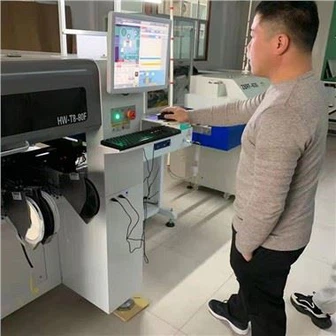
Mounter Related Standards
wave soldering machine
Flux coating device
1. The adjustment device is flexible in operation, the joints are intact, and there is no air leakage;
2. Coating device
Foaming form: The foaming effect is 80% uniform, and the bubbles formed are about 0.5~1.5mm in size (visual inspection);
Drum spray type: the drum rotates evenly and smoothly without noise, the mesh wall is not blocked, there is no centralized damage, and the air nozzle is not blocked;
Spray type: the nozzle is not blocked, and the mobile scanning operation is normal;
3. The liquid level of the accompanying flux is clearly displayed without clogging.
Preheater
There is no damage to the pre-heater, and the temperature adjustment controller works normally.
Solder bath
1. The temperature adjustment of the solder bath is in accordance with the equipment manual;
2. The solder wave height can be adjusted sensitively and kept stable. The pump body runs smoothly and without noise;
other parts
1. The adjustable guide rail can be adjusted freely and kept parallel. Adjust the width in accordance with the equipment manual;
2. The transmission chain is stable and normal, the speed adjustment conforms to the equipment manual, and the accuracy is controlled within ±0.1m/min;
3. The electrical equipment is complete, the pipelines are arranged in an orderly manner, and the performance is sensitive and reliable. The appearance of the instruments and meters is in good condition, the indication is accurate, and the reading is eye-catching, within the qualified service period;
4. The panel operation and display are normal, the operation handle buttons are flexible and reliable, and the computer control system works normally;
5. Regular maintenance inside and outside the equipment, no yellow robes, no greasy dirt.
reflow oven
1. The temperature control range conforms to the specifications of the specification, and the control accuracy is within ±2.0°C. 2. The speed control conforms to the specifications of the manual, and the accuracy is controlled within ±0.2m/min;
3. The lateral temperature difference of the substrate movement (≤150mm spacing) is within ±10.0℃;
4. The appearance of the heater is complete and the electrical connection is reliable. The hot air fan runs smoothly and without noise;
5. The guide rails can be adjusted freely and remain parallel. The effective width of the conveying substrate conforms to the specification;
6. The operating system works normally, the appearance of the instruments and meters is intact, the indication is accurate, and the reading is eye-catching, within the qualified use period;
7. Complete electrical equipment, orderly arrangement of pipelines, sensitive and reliable performance
8. Regular maintenance inside and outside the equipment, no yellow robes, no grease.
Analysis and solution of the main reasons for the placement machine throwing, and efficiency improvement Analysis of the main reasons for the placement machine throwing
In the SMT production process, how to control production costs and improve production efficiency is a matter of great concern to business owners and engineers, and these are closely related to the throwing rate of the placement machine. Let's talk about the throwing of the placement machine. material problem. The so-called material throwing means that the placement machine does not stick the material after sucking the material, but throws the material into the throwing box or other places, or performs the above material throwing action without sucking the material. Throwing causes material loss, prolongs production time, reduces production efficiency, and increases production cost. In order to optimize production efficiency and reduce costs, the problem of high throwing rate must be solved.
The main reasons and countermeasures for throwing materials:
Reason 1: The suction nozzle is defective, the suction nozzle is deformed, blocked, and damaged, resulting in insufficient air pressure and air leakage, resulting in the inability to absorb the material, the material is not taken correctly, and the material is thrown out because the identification cannot be passed. Countermeasures: clean and replace the nozzle;
Reason 2: Problems with the identification system, poor vision, unclean vision or laser lens, debris interfering with identification, improper selection of identification light source and insufficient intensity and grayscale, and the identification system may be broken. Countermeasures: Clean and wipe the surface of the identification system, keep it clean and free of debris, etc., adjust the intensity and gray level of the light source, and replace the parts of the identification system;
Reason 3: Position problem, the reclaiming material is not in the center of the material, the reclaiming height is not correct (generally, it is subject to pressing down 0.05MM after touching the part), which causes the offset, the reclaiming material is not correct, there is an offset, and the identification corresponds to the corresponding The data parameters do not match and are discarded by the identification system as invalid materials. Countermeasure: adjust the reclaiming position;
Reason 4: Vacuum problem, insufficient air pressure, unsmooth vacuum air pipe channel, guide object blocking the vacuum channel, or vacuum leakage caused insufficient air pressure and the material cannot be taken out or dropped on the way to paste after picking up. Countermeasures: adjust the air pressure steeply to the required air pressure value of the equipment (such as 0.5~0.6Mpa--YAMAHA mounter), clean the air pressure pipeline, and repair the leaking air path;
Reason 5: There is a problem with the program, the parameter settings of the components in the edited program are incorrect, and the parameters such as the actual size and brightness of the incoming material do not match, causing the recognition to fail and it is discarded. Countermeasures: Modify the component parameters and search for the best parameter settings of the component;
Reason 6: The problem of incoming materials, irregular incoming materials, unqualified products such as pin oxidation. Countermeasures: IQC does a good job of incoming material inspection and contacts with component suppliers;
Reason 7: The problem of the feeder, the position of the feeder is deformed, the feeding of the feeder is poor (the ratchet gear of the feeder is damaged, the material belt hole is not stuck on the ratchet gear of the feeder, there are foreign objects under the feeder, the spring Aging, or poor electrical), resulting in failure to reclaim or poor reclaiming and throwing, and damage to the feeder. Countermeasures: adjust the feeder, clean the feeder platform, and replace the damaged parts or feeder; when there is a phenomenon of throwing material to be solved, you can first ask the on-site personnel, and then directly find the problem based on the description and observation and analysis, so that It can more effectively identify and solve problems, and at the same time improve production efficiency, but does not occupy too much machine production time.
Testing Equipment
AOI (optical inspection machine), X-Ray detector, in-circuit tester (ICT), flying probe tester, etc.