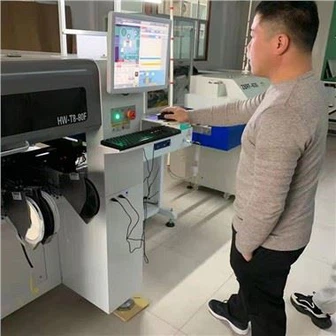
High-Precision Dancer : How Pick-and-Place Machines Accurately Capture Electronic Components
In the world of electronics manufacturing, pick-and-place machines are a crucial component. These machines are responsible for accurately capturing electronic components and placing them onto the printed circuit board (PCB). They are used in the production of everything from cell phones to aerospace devices.
The key to their accuracy lies in their high-precision "dancer". This is a term used to describe the mechanism that picks up the electronic components and places them onto the PCB.
The dancer is designed to work with a wide range of different electronic components. It is able to handle tiny surface-mount devices (SMDs) that are just a fraction of a millimeter in size, as well as larger components such as resistors and capacitors.
The dancer is made up of a number of different components, including suction cups, cameras, and sensors. These components work together to ensure that the electronic components are picked up and placed onto the PCB with extreme accuracy.
As the dancer moves over the components, the suction cups grip them firmly, preventing them from falling out of place. The cameras and sensors work together to ensure that the components are properly aligned and that they are placed onto the correct part of the PCB.
This high level of accuracy is essential for ensuring that the finished product works exactly as it should. Even the tiniest misalignment or mistake can result in a malfunctioning or non-functional device.
Overall, pick-and-place machines are an essential tool in the world of electronics manufacturing. Thanks to their high-precision dancers, they are able to accurately capture electronic components and place them onto the PCB, ensuring that the finished product is of the highest quality possible.